Search for content
Mobility Tech Update 2026

Realistic Models. Efficient Workflows. That's PTV Visum 27.

Model real-world mobility more accurately, streamline complex workflows and make better-informed transport decisions.

Download demo version Share your feedback

Bring Transport Models Closer to Reality

PTV Visum 27 brings transport models closer to real-world conditions while making complex modelling workflows easier to manage. New capabilities support collaborative model editing, automated calibration, measured travel-time integration and more detailed public transport analysis. Further enhancements help you represent emerging mobility services, refine assignments and demand models, automate scripting and keep environmental assessments current.
Download "What's New in PTV Visum 2027" (PDF)

Multi-User Model Editing in PTV Hub

Work on shared Visum models simultaneously through PTV Hub. When models are managed in PTV Hub, project members can edit the same model in parallel without relying on local files or manual synchronization. PTV Hub provides editing awareness, stores updated revisions and supports managed merging of changes from different users into the central model. Conflicting edits are flagged so teams can review and resolve them.

Automated Model Calibration Framework

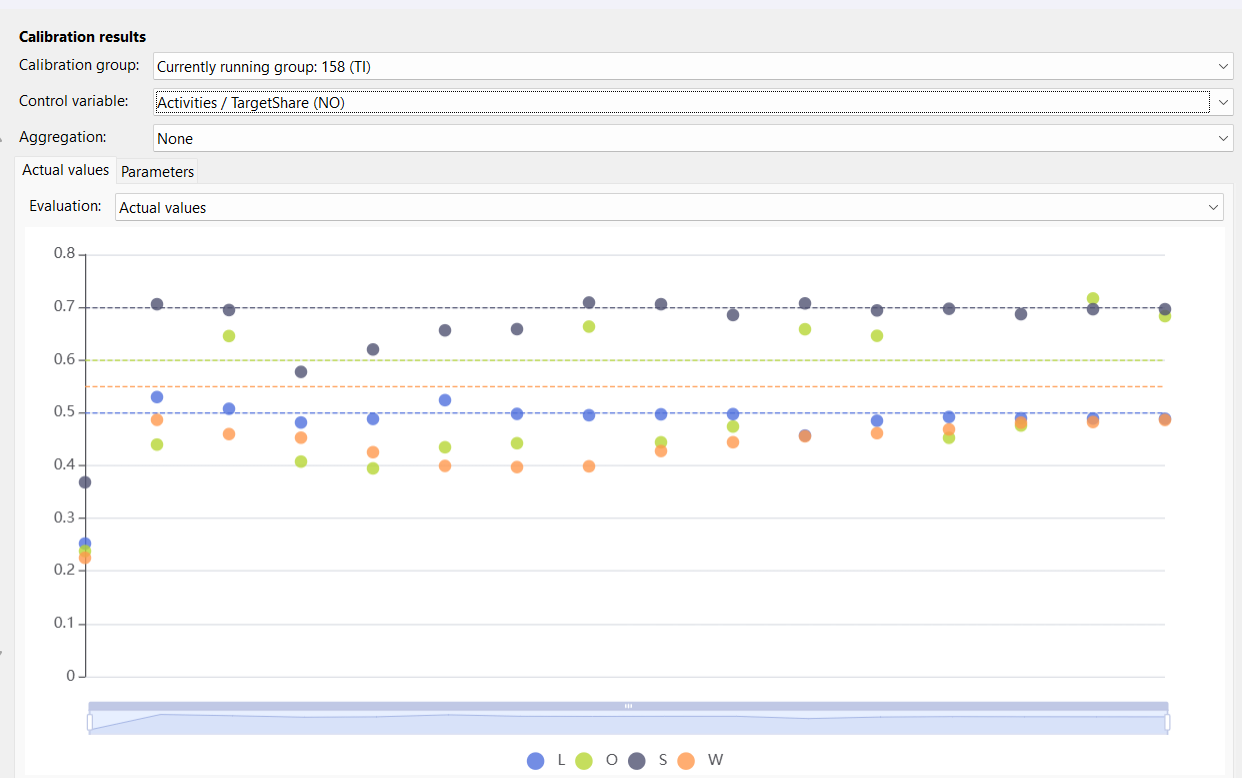
PTV Visum 2027 embeds model calibration directly into the modeling workflow. Users can define which parameters are adjusted, which measured targets must be met, and how the calibration process is structured. The framework then calibrates the whole model or selected parts using chosen optimization methods. Live and post-process convergence statistics support monitoring, reduce manual iterations, and make recalibration easier when targets or software versions change.

Measured Travel Times from PTV Flows

PTV Visum 2027 imports measured travel times from KPI corridors configured in PTV Flows. Historical travel times from real road segments are mapped to corresponding links in the Visum network, giving modelers direct access to observed network performance. This makes it faster to build and check realistic road models, validate modeled travel times, and use measured data in calibration workflows.

Connector-Free Public Transport Assignment

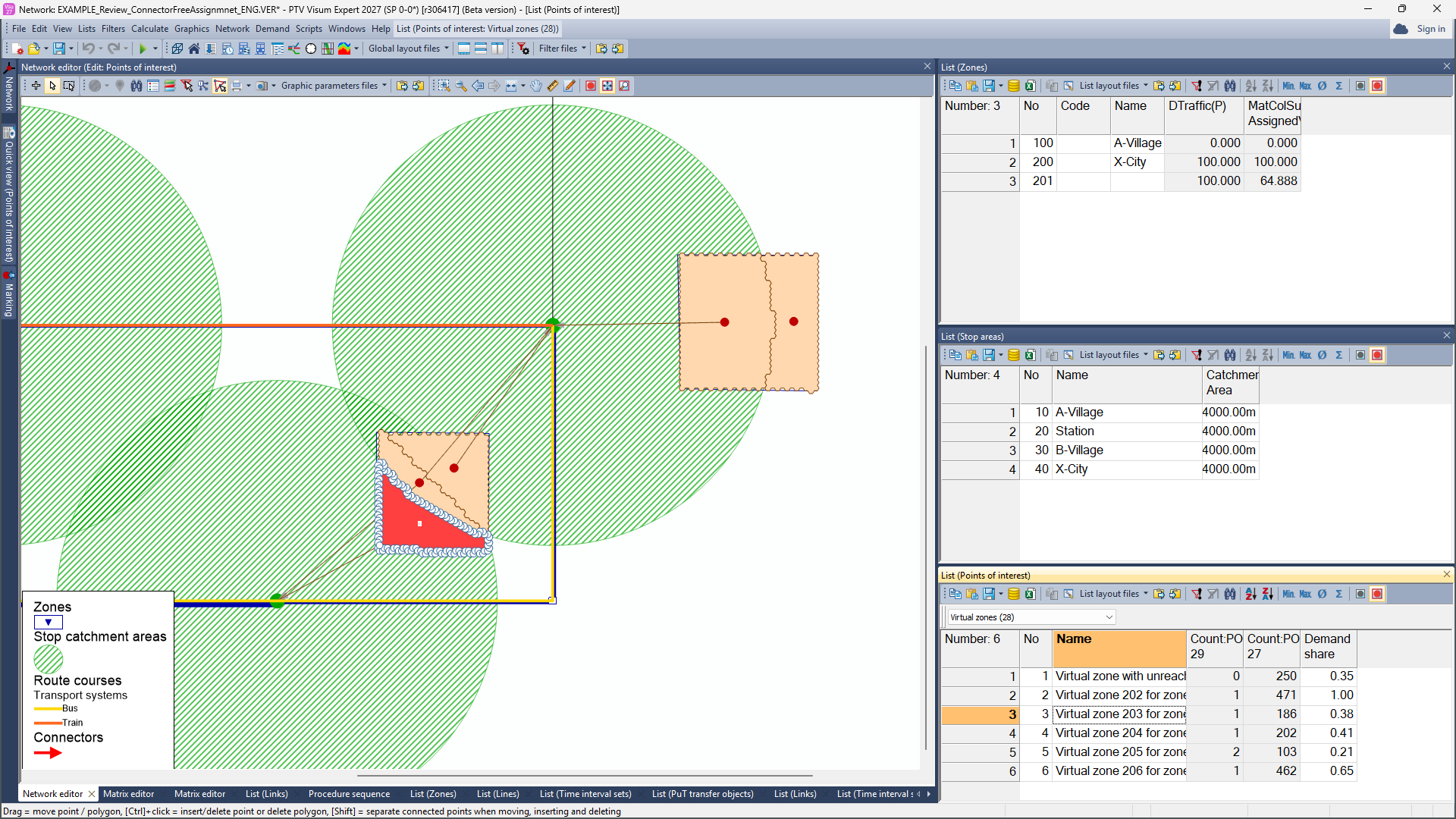
Access and egress to public transport can now be modelled without defining zone-to-stop connectors. Visum disaggregates zones to a virtual grid and allocates stops using catchment areas and time profiles, enabling high-resolution access and egress modelling with less effort in network building, checking and updating. The approach also makes stop-location scenarios easier to assess without increasing the licensed network size.

Rooftop Assessment of Public Transport Quality

Assess public transport impedance and quality of service directly in PTV Visum using the Rooftop method from the UK Passenger Demand Forecasting Handbook. Rooftop skims are available within the model, reducing the need to export assignment results to external evaluation tools and reimport assessments. The method supports an established rail-planning standard and prevents quality-of-service results from being skewed by additional, less attractive connections.

More Realistic Ride Pooling Models

Model ride pooling and on-demand services with greater control in Visum. Multiple, including overlapping, service areas can be considered while keeping each passenger within a single on-demand system. Requests can be filtered to avoid unrealistically short trips, and on-demand legs in public transport assignments are limited to feeder or last-mile use.

Assess Mixed Use of Public Transport Lanes

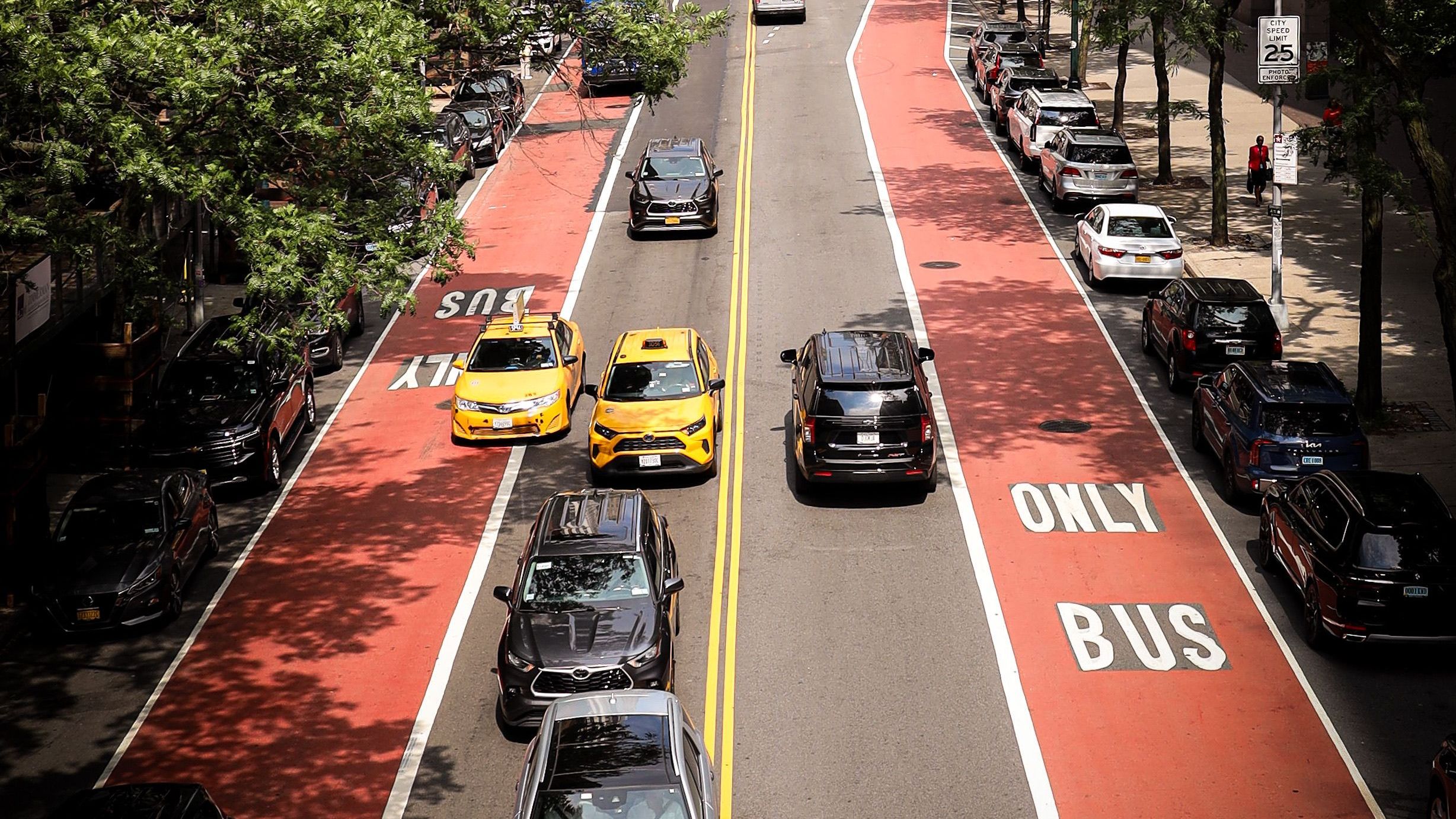
Model restricted mixed use of public transport lanes in Assignment with ICA. Lanes reserved for buses can also be opened to selected vehicle groups, such as taxis, and assessed in the same assignment context. This lets planners evaluate effects on volumes and travel times, supporting decisions on where mixed-use lanes should be introduced and how access should be configured.

Demand Matrix Estimation for Grouped Counts

Estimate demand matrices using measured counts that correspond to groups of network objects rather than single elements. This is useful when count locations cannot be matched directly to individual links because of model granularity or the physical layout of the network. By aligning modelled volumes and observations at matching geographic levels, PTV Visum reduces manual matching and aggregation work and speeds up calibration and model update workflows.

Improved ABM Population Synthesizer

Generate more representative synthetic persons and households for activity-based demand models (ABM) in PTV Visum. The improved population synthesizer accounts for aggregate statistics across different geographic levels and produces results comparable to outputs from PopSim. This supports fully integrated ABM workflows and scenario assessments without switching tools or transferring population data between applications.

Code Completion in the Script Editor

Write custom Python scripts in Visum with less time spent consulting documentation. The script editor now provides code completion for both the built-in Python API introduced in PTV Visum 2026 and the legacy COM API. This helps users enter supported commands and syntax more efficiently when extending procedure sequences with custom calculations or model-specific data processing.

Keep COPERT Emissions Calculations Current

Use updated COPERT data for environmental assessments in PTV Visum. PTV Visum 2027 supports COPERT 5.9.2, helping planners apply the current emissions model when evaluating decarbonization and air-quality impacts. PTV Visum continues to integrate COPERT alongside HBEFA, keeping emissions analysis available within established transport planning workflows.

Share your feedback on this release

Tell us which updates matter most to you and how they relate to your work or plans. 

Whether you use PTV Visum today or are considering it, your perspective helps us understand what to improve next. 

From trusted core towards a more connected future

PTV Visum 27 is part of a broader direction for mobility intelligence. 

Umovity is building on trusted PTV technology with connected applications and AI-enabled workflows—helping transportation teams move from planning and modeling to shared insights and decisions they can explain.

Explore Umovity’s product direction

Success Stories: Learn how our customers use PTV Visum

Success story
Bordeaux Metropole’s New Approach to Bicycle Traffic Modeling

To enhance the representation of bicycle traffic in its transport model, the city of Bordeaux launched a comprehensive cycling data collection initiative.

Learn more
Success story
Modeling taxi feeder routes to optimize new BRT network

Explore how PTV Model2Go and PTV Visum were used to design taxi feeder routes for Yaoundé, Cameroon, enhancing a planned Bus Rapid Transit network and improving urban mobility.

Learn more
Success story
Emergency Evacuation Planning Using Visum Simulation-Based Assignment

Explore how PTV Visum’s Simulation-Based Assignment (SBA) is being used to support wildfire and hurricane evacuation planning.

Learn more

Questions? Let’s explore what’s possible!