Transport Planning: Fundamentals, Objectives and Approaches
Transport planning forms the foundation of modern mobility. It determines how safely, efficiently and sustainably people and goods move within cities and regions.
This page provides an overview of the key aspects of transport planning – from objectives and processes to methods, tools and stakeholders.
It is intended for everyone who wants to understand mobility, plan transport systems and develop them responsibly.

Contents at a glance:
- What is transport planning?
- The transport planning process
- Planning frameworks and concepts in transport planning
- Tools and methods for implementing transport planning
- Sustainable transport planning and the mobility transition
- Roles and influence of stakeholders in transport planning
- Limitations and challenges of transport planning
- PTV: Your partner for transport planning
What is transport planning?
Transport planning is the strategic design of transport systems to organise mobility in an efficient, safe and environmentally sustainable way. It creates the conditions for a high-performing overall system that integrates all transport modes – from roads and railways to cycling and walking – and manages their use in a targeted manner.
In a municipal context, transport planning involves:
- estimating future travel demand based on forecasts of economic and demographic development as well as planned urban development or infrastructure projects,
- aligning spatial structures, transport services and regulatory frameworks,
- cooperation between political decision-makers, public authorities, experts and the public,
- and integrating transport, urban development and environmental considerations into a coherent overall system.
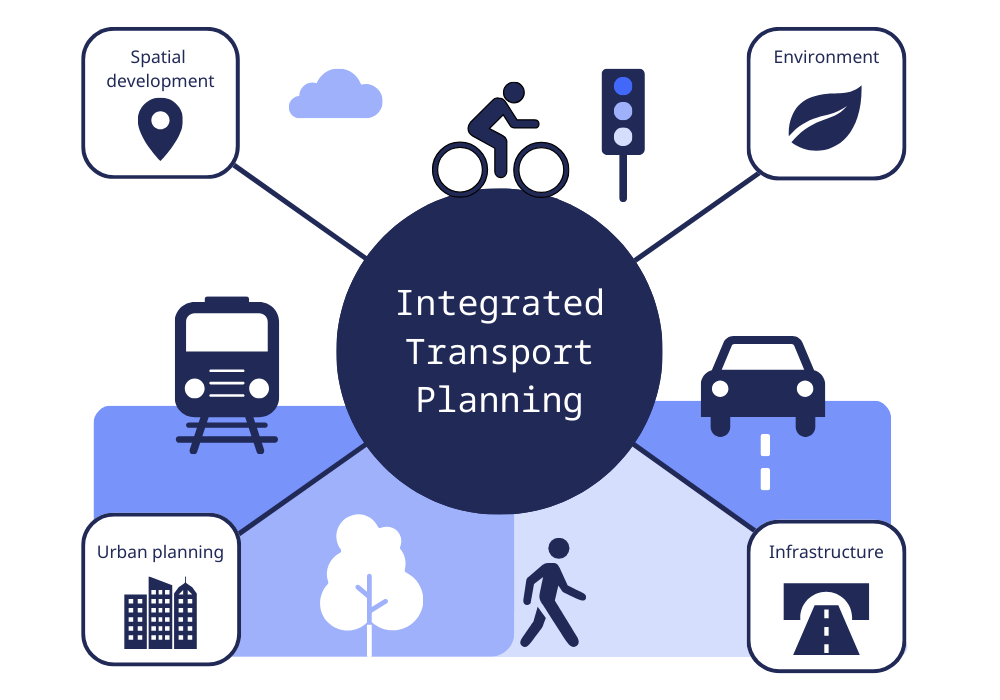
The interactions between transport, spatial and urban planning, the environment and infrastructure form the foundation of integrated transport planning.
A modern understanding of transport planning is based on an integrated approach. It considers the interactions between transport, spatial development and the environment in a holistic way and brings together disciplines such as urban planning, environmental planning, infrastructure development and transport management. The objective is mobility that is efficient, safe, resource-efficient and socially equitable.
At the same time, transport planning is forward-looking. By analysing travel patterns, demographic developments and technological trends, it provides the basis for assessing, refining and translating politically defined objectives into implementable strategies.
This makes it possible to estimate future mobility demand and, based on this, to develop spatial concepts, investments and infrastructure measures in a targeted and coordinated manner.
The Transport planning process
Transport planning follows a structured and iterative process, ranging from the analysis of the initial situation through the development and implementation of measures to their subsequent evaluation. The objective is to support well-founded decisions based on robust data and to systematically develop the transport system over time.
Step 1: Analysis of the initial situation
Every transport planning process begins with an analysis of the initial situation. Its purpose is to understand existing traffic conditions and their underlying causes.
Municipal transport analyses draw on a wide range of data sources, including traffic counts, mobility and household surveys, public transport operational data, floating car data, air pollution measurements, congestion and travel time information, accident data and land-use information. Traffic is often structured into transport zones (or traffic cells in the context of transport modelling) in order to systematically capture origin-destination flows.
In addition to transport data, spatial and socio-economic framework conditions are taken into account, such as settlement development, the distribution of workplaces, and the location of retail, educational and leisure facilities. Social structures and environmental impacts are also considered. Only this integrated perspective makes it possible to reliably identify issues such as capacity constraints, accessibility deficits or conflicts of use.
At the core of the analysis is the question of where transport problems currently exist, what impacts they have on people and the economy, and where new challenges can be expected in the future, also with regard to defined objectives.
The analysis therefore provides a key foundation for the further specification of objectives as well as for the development and assessment of measures.
Step 2: Definition of objectives and guiding principles
Following the analysis, objectives and guiding principles are defined. They specify the future direction of the transport system and provide a shared frame of reference for political decision-makers, public authorities and the public.
Guiding principles translate overarching societal and political objectives, for example from climate, environmental or urban development policy, to the level of mobility and make them more concrete in terms of safety, environmental sustainability, accessibility, efficiency and quality of life.
Objectives are formulated in measurable terms, for instance through indicators such as CO₂ emissions, land take or modal split. In addition to strategic objectives, legal and regulatory requirements also play a key role in defining the scope for action in transport planning. For example, climate protection and climate mobility legislation establishes binding framework conditions for emissions reductions and the design of future mobility systems.
On this basis, progress can be monitored and measures can be steered in a targeted manner. At the same time, it is important to explicitly identify goal conflicts, for example between efficiency and environmental sustainability or between safety and speed, and to transparently balance these in the interest of sustainable mobility.
Example: City of Stuttgart
A current example is provided by the City of Stuttgart. With its Transport Development Plan 2030, the city defines clear guiding principles and objectives, including more sustainable mobility and an improvement in quality of life while maintaining or reducing overall traffic volumes.

With its 2030 transport development concept, the state capital of Stuttgart has defined clear principles and objectives, including more sustainable mobility and improved quality of life with the same or reduced traffic volumes.
Step 3: Measures
The development of measures translates strategic objectives into concrete actions, ranging from infrastructure and control to communication.
In municipal transport planning, this includes structural and organisational measures as well as regulatory and communicative approaches.
Examples include:
- Infrastructure measures: street space design, expansion of cycling and walking infrastructure, accessibility, public transport facilities.
- Traffic control and management: parking management, speed management, priority signalling.
- Mobility services and incentives: sharing systems, multimodal hubs, fare and service frequency optimisation in public transport.
- Communication and participation: behaviour change campaigns, involvement of the public.
An integrated approach is essential: individual measures are combined into packages of measures in order to reinforce each other – for example through the combination of parking management, cycling infrastructure expansion and improvements to public transport.
Their effectiveness is assessed using target indicators such as traffic volumes, CO₂ emissions or modal split and compared with alternative options. This results in a coherent package of measures that brings together technical logic, political feasibility and public acceptance, and provides the basis for subsequent evaluation and decision-making.

Digital transport models are commonly used to assess transport measures. They realistically represent traffic flows, network loads and emissions and enable the evaluation of future scenarios. With PTV Visum, a city or region can be modelled as a digital twin, allowing different scenarios to be tested and their impacts to be assessed objectively. This enables cities and planning consultancies to make well-founded decisions based on robust forecasts.
Planning frameworks and concepts in transport planning
Transport planning is based on a range of strategic and operational planning instruments that provide the framework for all subsequent steps. They define which objectives are pursued and which analyses are carried out before concrete measures are developed.
Transport Development Plan
The Transport Development Plan is the central strategic instrument of municipal transport planning. It defines the long-term mobility strategy of a city or region and links transport-related, urban development and environmental objectives. It brings together analysis, the definition of objectives, the development of measures and their evaluation. This results in an integrated concept that forms the basis for political decision-making and investment.
The plan is usually prepared on behalf of the local authority, formally adopted by political bodies and regularly updated, typically with a planning horizon of 10 to 15 years.

Example: City of Hamburg
The city of Hamburg is pursuing an ambitious mobility transition strategy based on its SUMP Mobility Transition Strategy, with the aim of reducing CO₂ emissions by 70 % by 2030 compared to 1990 levels. A central measure is a change in the modal split: less motorised private transport and a significantly higher share of public transport, cycling and walking in overall travel.
Thematic mobility concepts
In addition to the Transport Development Plan, specific mobility concepts are often developed to address individual fields of action in greater depth. These include, for example:
- cycling or walking strategies,
- public transport or parking management concepts,
- mobility management or charging infrastructure concepts.
These sub-concepts translate the guiding principles defined in the Transport Development Plan into concrete actions and enable detailed, practice-oriented implementation at district or neighbourhood level.
Integration into other sectoral plans
A modern planning framework is characterised by integrated transport planning. It links transport concepts with urban development as well as environmental and climate policy. A coherent and sustainable mobility system can only be achieved when all sectoral plans, from land-use planning to mobility concepts, pursue shared objectives.
EU framework and SUMPs – strategic orientation for transport planning
At European level, transport planning is increasingly guided by Sustainable Urban Mobility Plans (SUMPs) as a recognised framework for integrated and sustainable mobility development. SUMPs link transport objectives with climate, environmental, urban development and social goals, and provide recommendations on processes, stakeholder involvement, implementation and monitoring.
The European Union supports local authorities through guidelines, monitoring approaches and funding programmes. According to the EU Urban Mobility Observatory SUMP database, more than 400 urban areas across Europe are currently covered by Sustainable Urban Mobility Plans, underlining their widespread adoption and their status as a best-practice approach.
Tools and methods for implementing transport planning
Once strategic concepts have been defined, the tools and methods used to carry out analyses, assessments and simulations come into play. They make the objectives of the Transport Development Plan measurable and provide a robust basis for decision-making.
Data foundations
Reliable transport and environmental data form the basis of all transport planning activities. This includes geospatial data (GIS), such as transport networks as well as population, land-use and economic data; information on travel behaviour, for example from household surveys or mobile phone data; and traffic counts, floating car data and public transport operational data used to analyse current traffic conditions and to calibrate and validate models.
By combining different data sources, traffic volumes, trip purposes and network loads can be captured with a high degree of accuracy. Real-time data and open data portals are becoming increasingly important, as they enable short-term analyses and more flexible planning decisions.
Digital tools and smart planning
Digital transport planning goes beyond traditional modelling. It links data analysis, simulation and communication into a continuous, connected planning process. Data from traffic counts, sensors, mobile networks and open data portals are combined in integrated platforms and continuously updated. This creates a digital representation of the transport system - the so-called digital twin.
Using this digital twin, planners can simulate scenarios, visualise impacts and support informed dialogue with political decision-makers and the public. Transport planning thus becomes not only data-driven, but also interactive and adaptive: new information is continuously fed back into analyses, assessments and decisions.
Sustainable transport planning and mobility transition
Sustainable transport planning aims to shape mobility in a way that meets today’s needs without compromising the opportunities of future generations. It integrates environmental, social and economic considerations and therefore forms the core of the so-called mobility transition.
At the heart of this approach is the question of how cities and regions can avoid, shift and improve transport. These are the three fundamental principles of sustainable mobility:
- Avoid transport: through compact settlement structures, short travel distances and digital solutions that replace physical mobility.
- Shift transport: from private motorised transport to environmentally friendly transport modes such as walking, cycling and public transport.
- Improve transport: through efficient propulsion technologies, intelligent control, traffic management and digitalisation.
Municipal transport planning plays a key role in this process. It can enable a fairer distribution of space, promote zero-emission forms of mobility and help make public spaces more liveable.
In practice:
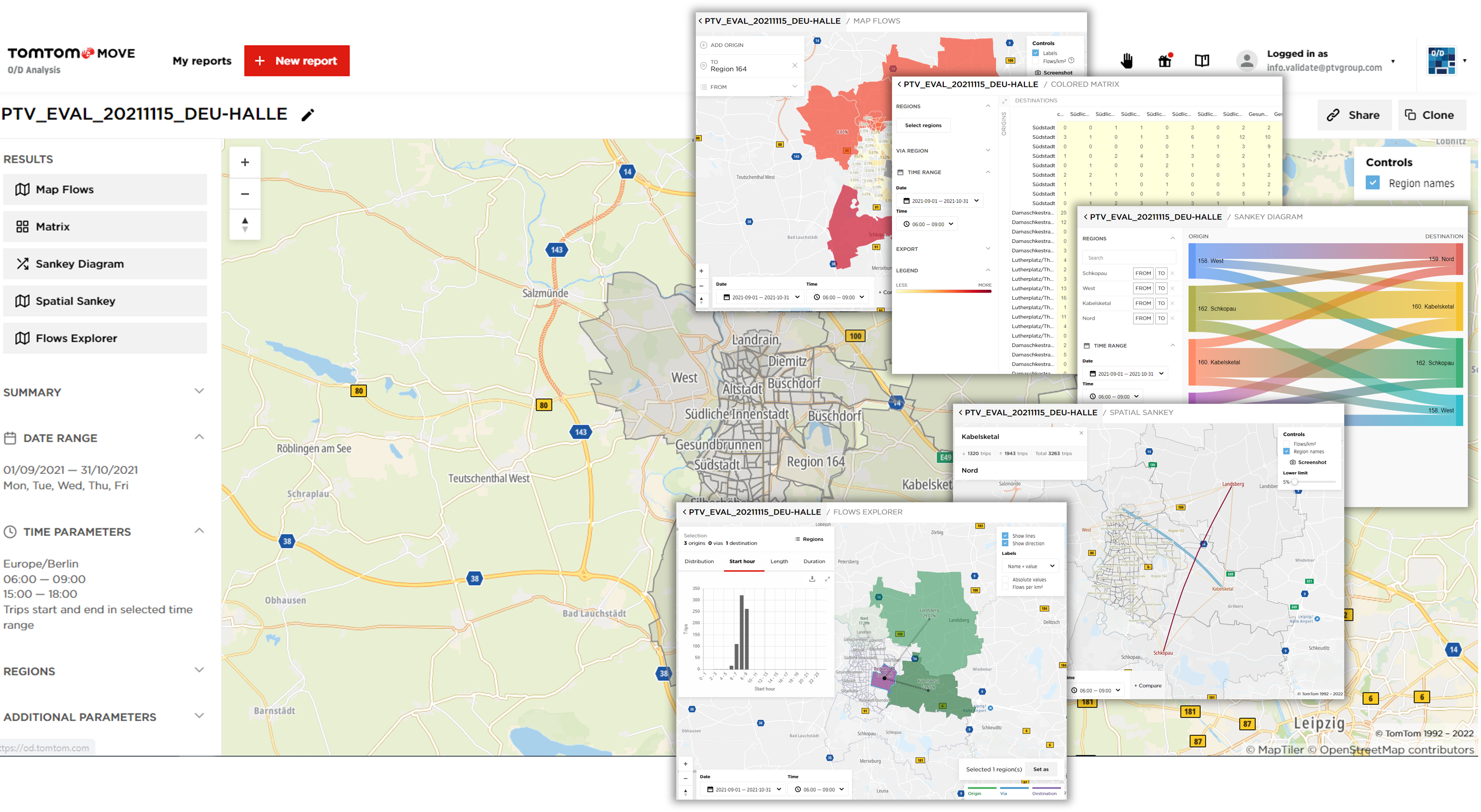
Data form the foundation of all sound transport planning, and their quality determines the reliability of all analyses. With PTV mobility data, local authorities can bring together transport data from a wide range of sources, validate it and prepare it for informed planning decisions.
Analysis and modelling
Digital transport models are used to analyse and forecast traffic conditions. These models describe transport demand - that is, where trips originate, what their destinations are and which transport modes are used and then assign this demand to the transport network. On this basis, traffic flows, bottlenecks and emissions can be analysed, and the impacts of planned measures can be assessed.
In practice
PTV Visum is used for this modelling and for the assessment of transport measures. It provides a realistic representation of cities, regions or entire countries, analyses transport demand and enables robust forecasts to support both strategic and operational decision-making.

Freiburg is promoting active mobility through its walking and cycling initiative.
Numerous cities, including Stuttgart (with a focus on expanding cycling infrastructure and public transport as part of its Transport Development Plan 2030) and Freiburg (with its walking and cycling initiative), demonstrate how targeted investments in cycling networks, public transport expansion and traffic management can deliver sustainable outcomes.
In addition to environmental objectives, sustainable transport planning also addresses social aspects, such as equal access to mobility for all population groups, barrier-free access and safe routes. In this way, mobility becomes not only more climate-friendly, but also more equitable.
Roles and influence of stakeholders in transport planning
Transport planning is not the responsibility of a single institution. Instead, it involves multiple levels of governance and a wide range of stakeholders, each with different roles, areas of responsibility and funding roles.
National and European level
At national and European level, strategic frameworks for transport and mobility are defined. This includes setting policy objectives, establishing legal frameworks and long-term targets, as well as providing funding programmes that support transport planning and implementation at lower governance levels.
At European level, several key frameworks and funding instruments shape integrated and sustainable transport planning:
- European Urban Mobility Framework / Sustainable Urban Mobility Plans (SUMPs)
SUMPs are promoted as a best-practice framework for integrated urban mobility planning. They link transport objectives with climate, environmental and social goals and provide guidance on stakeholder involvement, implementation and monitoring.
- Connecting Europe Facility (CEF)
The CEF supports strategic investments in transport infrastructure, digitalisation and cross-border connectivity, contributing to efficient, resilient and climate-neutral transport systems.
- Horizon Europe
Horizon Europe funds research and innovation in transport, including modelling, data integration, digital twins and smart mobility solutions under the Climate, Energy and Mobility cluster.
At national level, governments translate these European frameworks into country-specific transport strategies and funding mechanisms. They define regulatory requirements, national climate and mobility targets, and provide financial instruments that enable regional and local authorities to plan and implement transport measures.
While national and European levels define objectives and financial conditions, operational delivery is usually carried out at regional and local level.
Regional and metropolitan level
Regional and metropolitan authorities act as a coordinating layer between national objectives and local implementation. Their responsibilities typically include developing regional transport strategies, managing funding programmes, coordinating across administrative boundaries and ensuring consistency across transport networks.
This level is particularly important for addressing mobility challenges that extend beyond individual municipalities, such as commuter flows, regional public transport systems and inter-urban infrastructure.
Local level
Local authorities carry primary operational responsibility for transport planning. They develop transport strategies and plans, define concrete measures and implement them on the ground. This includes decisions on street space allocation, public transport services, traffic management and active mobility infrastructure.
Local authorities often need to secure co-funding and apply for external funding, while managing planning processes, stakeholder engagement and project delivery. In practice, higher governance levels frequently provide strategic direction and funding, while municipalities are responsible for implementation and day-to-day operation.
Other stakeholders
In addition to public authorities, a range of other stakeholders play an important role in transport planning:
- Public transport authorities and operators
They plan, operate and manage public transport services and networks and are key partners in service design, capacity planning and operational optimisation.
- Planning consultancies and research institutions
These organisations contribute technical expertise, modelling tools, data analysis and impact assessments that support evidence-based decision-making.
- Private sector and technology providers
Companies supplying data, digital platforms, mobility services or infrastructure technologies increasingly influence planning options and implementation pathways.
- The public, civil society organisations and interest groups
Citizens, associations and stakeholder groups shape transport planning through participation processes, consultation, feedback and public acceptance. Their involvement is essential for social legitimacy and long-term success.
Limitations and challenges of transport planning
Transport planning always operates at the intersection of technical, political and societal interests. Despite modern methods, digital tools and clearly defined guiding principles, it faces a number of limitations and challenges in practice.
Political and institutional constraints
Transport planning is inherently a long-term process, while political decision-making cycles are often short. As a result, strategic objectives defined in transport development plans or mobility strategies can easily come into conflict with short-term expectations. In addition, the distribution of responsibilities across national, regional and local levels can complicate coordinated implementation, as funding mechanisms, legal frameworks and approval procedures are often fragmented.
Financial and human resources
Many local authorities have limited financial and staffing resources to plan, implement and regularly update comprehensive transport projects. Funding programmes frequently require substantial co-financing and administrative capacity. This can lead to delays or increased reliance on external planning consultancies.
Social acceptance and goal conflicts
Transport planning must balance a wide range of interests, including fair allocation of space between transport modes, economic efficiency, environmental and climate protection, safety and comfort. Measures such as parking management, speed reductions or street space reallocation often encounter public resistance. Open dialogue and transparent participation processes are therefore essential to build acceptance and trust.
Technical and methodological challenges
Despite ongoing digital progress, data gaps, legacy systems and heterogeneous data sources remain a challenge. Forecasts are inherently uncertain, for example due to demographic change, emerging mobility services or disruptive technologies. Transport planning therefore needs to remain flexible and be regularly reviewed in order to integrate new developments and respond to changing conditions.
PTV: Your partner for transport planning
The demands placed on modern transport planning are increasing. Complex data sets, ambitious climate targets and limited resources present cities and regions with new challenges. PTV supports local authorities, public agencies and engineering consultancies in addressing these tasks in a systematic and data-driven way.
With a comprehensive portfolio comprising software solutions, mobility data and planning and consulting services, PTV provides a complete ecosystem for analysis, modelling, simulation and evaluation. This enables transport and mobility strategies to be developed and implemented efficiently.
Through close collaboration with cities, research institutions and specialist consultancies, PTV builds long-term and reliable partnerships. PTV supports integrated transport planning, the implementation of digital transport models and the training of professionals – ensuring that mobility strategies are not only developed, but successfully put into practice.
Ready to take your transportation planning initiatives to the next level?
Get your free demo version of PTV Visum - the world’s leading transport planning software - or get in touch with our experts. Transportation planning solutions are at your fingertips:
Examples of transportation planning
Abu Dhabi uses PTV Visum to create a sustainable bus planning model.

PTV Visum helps Swiss Federal Railways transport millions of goods and consumers.

Transportation planners in Copenhagen apply PTV Vissim to realistically simulate current and future motor traffic to support their bicycle-friendly city.

FAQs about transportation planning
What is strategic transportation planning?
Strategic transportation planning is a method of examining ways to cater to mobility needs within a region. This includes all mobility demands, from pedestrian traffic to motorized traffic. It also incorporates the movement of goods and services required for a thriving economy.
What is urban transportation planning?
Urban transportation planning analyzes current infrastructures within metropolitan areas and suggests ways to make improvements. This includes curating an efficient, balanced transportation system for optimal urban mobility within a city.
What is transport policy?
Transport policy refers to how government officials review and amend changes for particular transit issues. The level of government that takes this responsibility depends on the region, the challenges, and the scope of proposed improvements. This can be either private or public policy aimed at curtailing adverse effects on inhabitants’ health and overall well-being.
What are the objectives of the transportation planning process?
The specific objectives of the transportation planning process depend on the challenges a region faces. Most commonly, these include:
- Improving the efficiency of transportation for businesses and transport providers.
- Improving economic efficiency of transport for consumers.
- Creating a more reliable transportation system.
- Providing positive long-term, sustainable economic impacts on the region.
What is a transportation planning engineer?
A transportation planning engineer is tasked with simulating transport problems based on the current infrastructure of a region. This is done through computer models, software, and simulations of proposed solutions. Transportation planning engineers must begin with analyzing and interpreting data gathered to examine various schemes to manage traffic and propose improvements. They’re also responsible for forecasting the impact of future developments on transportation.
What is a transportation analysis?
A transportation analysis is an overarching way of evaluating and analyzing issues related to the infrastructure of transport. This includes everything from travel habits, transit preferences, modes of transportation, and their impact on the region. It’s a comprehensive overview of how transit affects a defined area.