How to Plan Mobility for Major Events
Major events place exceptional demands on transport networks, public transport, pedestrian infrastructure and surrounding communities. Unlike everyday mobility, visitors arrive and depart within short periods, requiring coordinated planning across multiple transport modes and stakeholders.
This guide explores the key principles of event mobility planning, including common challenges, the planning process and how planning, prediction and real-time traffic intelligence support better decisions before, during and after major events.

What Is Event Mobility Planning?
Event mobility planning is the process of preparing transport systems for the unique travel demand created by major events. It brings together planning for road traffic, public transport, pedestrian movement, parking, temporary traffic management, emergency access and visitor operations to ensure people can arrive, move around and leave an event safely and efficiently. Beyond maintaining safe and reliable operations, event mobility planning also supports broader objectives such as improving accessibility, encouraging sustainable travel choices and reducing the environmental impact of event-related transport.
Planning these elements typically involves multiple stakeholders, including municipal authorities, transport operators, venue managers, engineering consultants, emergency services and event organisers. While roles and responsibilities vary between countries and projects, successful event mobility planning depends on effective coordination throughout the event lifecycle.
This integrated approach is what we call Event Mobility Intelligence: connecting planning, prediction, live operations and continuous improvement across the event lifecycle.
Challenges in Event Mobility Planning
Planning for a major event means making critical decisions long before the first visitors arrive. Many of these decisions are based on forecasts, previous experience and planning assumptions rather than real-world conditions, while the consequences often only become visible once the event is underway.
While every event is unique, the underlying planning challenges remain remarkably consistent. The following factors shape mobility planning for almost every major event:
1. Planning Under Uncertainty
Event mobility plans are developed before real conditions are known. Even when expected attendance is known in advance through ticket sales, arrival patterns, travel behavior and weather conditions remain uncertain and are based on forecasts, experience and planning assumptions.
Planning Insight: Even minor factors can influence how people move. After heavy rain, for example, pedestrians often change their routes to avoid puddles, creating different walking patterns and crowd densities than originally anticipated.
2. Interconnected Transport Systems
Road traffic, public transport, pedestrian movement, parking and temporary traffic management influence one another. Decisions made in one area can create unintended impacts elsewhere across the transport network.
Planning Insight: During the opening concerts at Rogers Stadium in Toronto in 2025, long pedestrian queues and congestion around transport hubs highlighted how closely venue access, pedestrian movement, public transport and private traffic are connected.
3. Balancing Multiple Objectives
Event mobility planning must balance traffic flow, public transport performance, accessibility, safety and operational efficiency. Optimizing one objective often requires trade-offs in another.
4. Coordinating Multiple Stakeholders
Cities, transport authorities, venue operators, event organizers, consultants and emergency services all contribute to the planning process. Successful event mobility depends on coordinated decisions and a shared understanding of the wider transport system.
5. Limited Opportunity to Test
Major events leave little room for trial and error. Mobility concepts, operational procedures and contingency measures must therefore be evaluated before they are implemented under real event conditions.
Event Mobility Intelligence: From Planning to Continuous Improvement
Event Mobility Intelligence connects planning, prediction, live operations and continuous improvement into one decision-making process for major events. Rather than treating these activities separately, the approach links strategic planning, detailed simulation and real-time traffic intelligence. Insights from live operations can then be used to strengthen future models, assumptions and mobility strategies.
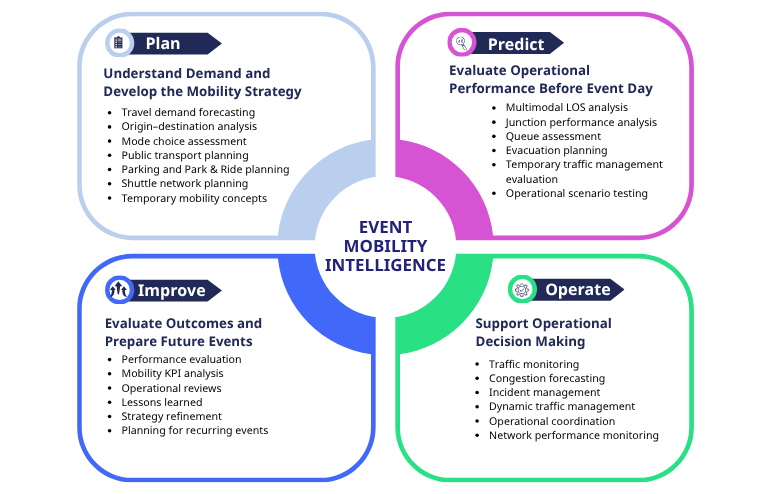
- PLAN with a network-wide understanding of demand.
- PREDICT with detailed multimodal simulation.
- OPERATE with real-time traffic intelligence.
- IMPROVE by using observed conditions to strengthen future models and plans.
Event Mobility Planning Checklist
Assess your current planning approach with our Major Event Mobility Planning Checklist and identify areas that may require further analysis.
The Event Mobility Planning Process
Successful event mobility planning is not a single activity but a continuous process that connects planning, prediction, live operations and post-event learning. Event Mobility Intelligence structures this process into four connected stages:
Step 1: PLAN - Understand Demand and Develop the Mobility Strategy
Planning starts with understanding where visitors come from, when they travel and which transport modes they are likely to use. This network-wide view helps planners assess how event demand interacts with everyday traffic and public transport.
Based on this understanding, mobility concepts can be developed for access and egress, public transport, parking, Park & Ride, shuttle services, pedestrian routing and temporary traffic management.
Typical activities:
- Travel demand and origin-destination analysis
- Mode choice and multimodal mobility planning
- Public transport, shuttle and Park & Ride planning
- Access, ingress and egress planning
- Pedestrian routing
- Temporary traffic management
Step 2: PREDICT - Test Mobility Concepts Before Event Day
Once a mobility concept has been developed, detailed multimodal simulation helps planners understand how it is likely to perform under different demand and operating conditions.
Traffic and pedestrian simulations can reveal bottlenecks, queues and conflicts between vehicles, public transport and pedestrians. Alternative scenarios can then be compared before measures are implemented.
Typical activities:
- Traffic and public transport simulation
- Pedestrian and crowd simulation
- Queue, capacity and junction analysis
- Ingress, egress and evacuation assessment
- Scenario and contingency testing
- Assessment of temporary traffic measures
Step 3: OPERATE - Use Real-Time Traffic Intelligence
Once the event is underway, real-time traffic intelligence helps operational teams understand how conditions are developing across the network and where action may be required.
Live data and short-term forecasts can reveal congestion, incidents and deviations from the plan, allowing teams to respond proactively and adapt traffic-management measures as conditions change.
Typical activities:
- Real-time traffic monitoring and short-term forecasting
- Incident detection and management
- Dynamic traffic management
- Implementation of diversion and alternative traffic measures
Step 4: IMPROVE - Learn from Real Event Conditions
Every event generates valuable operational data. Comparing predicted conditions with observed performance helps organisations understand where assumptions were accurate and where models, plans or operating strategies should be refined.
These insights strengthen future planning, particularly for recurring events, by improving demand forecasts, model inputs, contingency strategies and operational procedures.
Typical activities:
- Post-event performance and KPI evaluation
- Comparison of predicted and observed conditions
- Review of demand and mode-share assumptions
- Refinement of models and planning assumptions
- Lessons learned and strategy refinement
- Planning for future or recurring events
Discover the technology behind Event Mobility Intelligence
Whether you are preparing a stadium opening, city festival, major sports event, concert, exhibition or recurring venue operation, PTV helps you connect planning, prediction, operations and learning into one evidence-based mobility approach.
How PTV Supports Event Mobility
Organizations have different resources, technical capabilities and planning requirements. Some manage event mobility analysis and operations with their own specialist teams, while others require external expertise for individual tasks or the complete project.
PTV supports both approaches. Organizations can use PTV software independently, work with PTV Professional Services or combine software and expert support across the event lifecycle.
| Use PTV Software |
PTV software supports planning, simulation and live traffic operations for major events:
|
| Get Support |
PTV experts can support individual planning tasks or the complete event mobility workflow. Typical services include:
|
| Combine Software and Expert Support |
PTV software and professional services can also be combined. Our experts can develop and validate models, support a specific event and transfer methods and processes to internal teams for future use. |
Mobility Planning Across Different Event Types
Every event presents different mobility requirements. The examples below show how planning priorities change depending on the event type and operating environment.
Stadiums & Arenas
Managing concentrated arrivals and departures, coordinating multimodal access, public transport services, parking and pick-up/drop-off operations, and ensuring safe pedestrian circulation and egress.
Concerts & Festivals
Planning temporary transport infrastructure, shuttle services, park-and-ride facilities, pick-up and drop-off operations, and pedestrian management while adapting to changing visitor behavior, weather conditions and site-specific constraints.
City-Wide Events
Coordinating road closures, traffic diversions and public transport services while maintaining mobility for residents, businesses and emergency services across the wider transport network.
Exhibition & Convention Centres
Managing recurring visitor peaks, multimodal access, parking demand and logistics traffic while ensuring efficient circulation throughout the venue and surrounding transport network.
Airports & Transport Hubs
Coordinating passenger flows, public transport connections, taxi and pick-up/drop-off operations while maintaining reliable network performance during periods of exceptional demand.
International Sporting Events
Coordinating mobility across multiple venues, transport operators and stakeholder organizations while preparing for repeated demand peaks, changing operational conditions and long event durations.


Planning a major event? Let’s make mobility risks visible before your event day.
Whether you are facing a current event planning challenge or simply want to explore how traffic and pedestrian simulation could support your city, our experts are here to help.
Event mobility needs to be planned as an integrated system, not in isolated parts. With our experience, we help you take a step back, see the bigger picture and understand how traffic, public transport, pedestrian flows, parking and access routes interact.
Talk to us about your event, your mobility questions or the right way to get started, from expert-led simulation projects to support for your own planning team.