Search for content
Mobility Tech Update 2026

Detailed Simulations. Connected Workflows. That’s PTV Vissim 27.

Simulate traffic and pedestrian movement in greater detail, streamline collaborative workflows and strengthen support for automated vehicle testing.

Download demo version Share your feedback

Microscopic Detail Paired with Connected Workflows

PTV Vissim and PTV Viswalk 2027 help you build, review and refine simulation models with less manual effort. The new version introduces collaborative model workflows in PTV Hub, improved tools for merging and diverging lanes, stronger OpenDRIVE and OpenSCENARIO support for AV testing, and practical PTV Viswalk enhancements for pedestrian routing, alighting and waiting behavior.

Download "What's New in PTV Vissim 2027" (PDF)

Collaborative Model Workflows in PTV Hub

Work on shared PTV Vissim and PTV Viswalk models through PTV Hub. When models are managed in PTV Hub, project members can edit in parallel instead of coordinating local files manually. PTV Hub provides editing awareness, stores updated revisions and supports managed merging and conflict handling. Teams can also attach cloud-based comments to network objects, helping modelers, reviewers and stakeholders communicate clearly in context.

Easier Editing for Merging and Diverging Lanes

Define complex lane layouts with less effort: A new editor for merging and diverging lanes gives direct access to lane geometries and connections. It helps users create and adjust lane configurations more precisely in complex intersections and merging areas, while supporting the improved simulation behavior introduced for these situations.

More Realistic Merging Behavior

Model lane reductions with fewer workarounds: New merging connectors can start from multi-lane links and represent lane reductions directly. The added Arranging driving state lets vehicles on neighboring lanes deliberately create gaps before the merge, supporting fairer merging behavior and reducing the need for parameter tweaks.

Improved OpenDRIVE Import for AV Testing

Keep road information consistent across tools: PTV Vissim now uses OpenDRIVE road markings to set lane change restrictions and improve visualization after import. New options for georeferenced models also preserve local Cartesian coordinates, helping AV testing workflows maintain consistent model information between different software environments.

OpenSCENARIO Export for Replayable Test Cases

Turn PTV Vissim simulation results into AV scenarios: The OpenSCENARIO export uses PTV Vissim simulation results to provide replayable dynamic scenarios for third-party software and AV testing environments. It can export multi-segment vehicles, like trucks and trailers. Combined with incident detection, users can parameterize and filter simulations for interesting or challenging test situations.

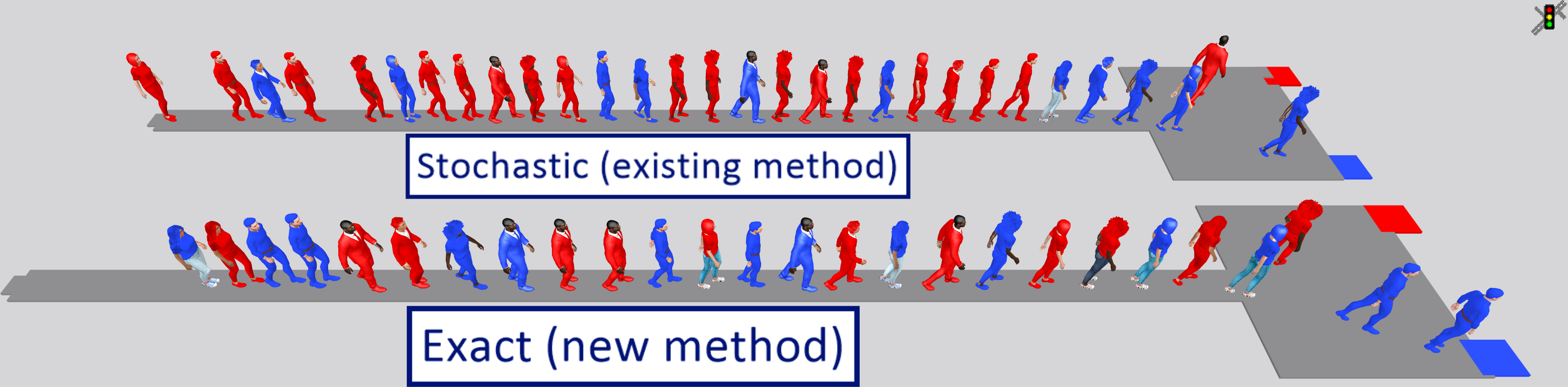
Exact Route Decisions for Pedestrians

Control pedestrian route splits deterministically: PTV Viswalk can now distribute pedestrians exactly between routes based on relative route flow values. This makes it possible to achieve precise route distributions within each decision interval and, when inputs are aligned, represent an exact OD matrix in the simulation.

Alighting Delay for Public Transport

Represent slower passenger flows at doors: A new Alighting Delay function lets users model delays when passengers leave a train, similar to the existing Boarding Delay function. This helps reflect situations where alighting flow is lower than cross-sectional door width alone would suggest.

More Options for Flexible Waiting Behavior in PTV Viswalk

Apply waiting behavior where it fits: Waiting behavior at a route waiting area and waiting behavior for a PT vehicle can now be used mutually in PTV Viswalk. This gives modelers more consistent options for representing how pedestrians wait along routes or for public transport vehicles.

Transparent Background Images for Clearer Models

Overlay project graphics while keeping the underlying background map visible: PTV Vissim 2027 supports transparent background images, making it easier to position site plans accurately by using the map as a reference. Users can also manage multiple overlapping layers of background images more easily. Network objects such as links and connectors remain visible above background images, as before. This is useful for site plans, architectural drawings, schematic layouts, zoning overlays and other project-specific visuals.

Expanded Examples for More Use Cases

Start projects with more ready-made references: The PTV Vissim example library now includes added and updated models for roadworks with reversible lanes, cableways, rail crossings with barriers and a multi-storey car park. Users can import and learn from these examples to speed up project setup.

Share your thoughts with us
 

From trusted core towards a more connected future

PTV Vissim 27 is part of a broader direction for mobility intelligence. 

Umovity is building on trusted PTV technology with connected applications and AI-enabled workflows—helping transportation teams move from planning and modeling to shared insights and decisions they can explain.

Explore Umovity’s product direction

Success Stories: Learn how our customers use PTV Vissim & Viswalk

Success story
Traffic Simulation for Luton Airport

Overcoming real-world complexities and delivering efficient, robust transportation solutions with PTV Vissim’s advanced simulation tools.

Learn more
Success story
Simulations Revolutionize Transportation Projects in Taiwan

Major transportation projects across Taiwan are advancing thanks to PTV simulation - ensuring better movement of people and goods. Here's how it's done.

Learn more
Success story
How traffic simulations boost automotive mobility development

Virtual test centers and simulation tools play a vital role in accelerating vehicle development. Haruka Nakandakari explains how they're being utilized at TTDC's new 'Digital Development DOJO'.

Learn more
Success story
Pedestrian Simulation Ensures Smooth Crowd Flow at Grand Palais Paris

As part of the extensive refurbishment of the Grand Palais in Paris, Systematica's consultants were entrusted with optimizing visitor flow and experience.

Learn more
Success story
Pedestrian flow simulation of new peak station at Tiltis, Switzerland

Using advanced pedestrian simulation PTV Viswalk, the operator ensures smooth, efficient, and unforgettable mountain adventures for everyone.

Learn more
Success story
Transforming a busy bus line: A data-driven BRT simulation

Can a Bus Rapid Transit corridor greatly improve service? Microscopic simulations by PTV Vissim and Viswalk in Stockholm reveal surprising insights into travel times, speeds and passenger flows.

Learn more

Questions? Contact our experts !