Search for content
PTV Vissim

Design cleaner, safer and truly multimodal mobility

Urban mobility is no longer about optimizing traffic flow for cars alone. Cities must balance safety, climate targets, public transport reliability, active mobility and limited urban space, while managing political risk and public expectations.

PTV Vissim enables municipalities and consultancies to evaluate these trade-offs through microscopic traffic simulation. By capturing interactions between vehicles, cyclists, pedestrians and public transport, it provides measurable evidence to support safer, cleaner and more reliable mobility strategies.

Download demo  Contact us

Street Redesign for Active Mobility

Urban streets are increasingly redesigned to prioritize cycling, walking and public transport. Reallocating road space, such as introducing protected or new bike paths, bus lanes or car-free zones, directly affects traffic circulation, intersection performance and overall network stability.

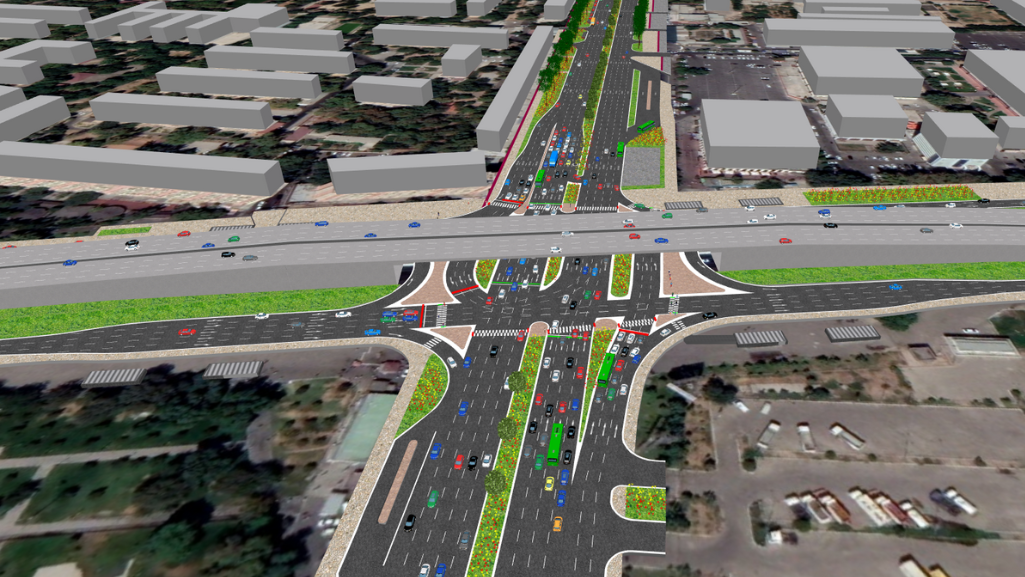
PTV Vissim enables planners to evaluate multimodal street redesign strategies within a microscopic traffic simulation before implementation. Alternative lane allocations and street layouts can be analyzed to understand how changes influence vehicle flow, public transport reliability and active mobility integration under consistent peak conditions.

The simulation makes interactions between cars, cyclists, pedestrians, and public transport measurable across each design scenario. Capacity constraints, queue development, spillback effects and potential conflict areas become visible at both intersection and corridor level. In addition, surrogate safety indicators such as time-to-collision and post-encroachment time can be derived from vehicle and pedestrian trajectories to identify high-risk areas proactively. Required signal timing adjustments can be implemented and tested directly to reflect modified geometries.

Through structured scenario comparison, cities gain a robust basis for selecting active mobility concepts that improve safety and accessibility while maintaining operational performance.

Public Transport Performance & Reliability

Public transport performance is often determined by how buses and trams operate within mixed traffic. Congestion, dwell time variability at stops and signal coordination along the corridor can quickly affect punctuality and service reliability, particularly under peak conditions.

Microscopic traffic simulation makes these operational effects measurable before changes are implemented in the field. PTV Vissim represents public transport vehicles within the surrounding traffic flow, capturing interactions with private vehicles, cyclists and pedestrians under realistic traffic scenarios.

Stop operations and passenger boarding behavior are reflected in the simulation, allowing assessment of how dwell time variability influences headway stability and travel time reliability. Signal priority measures, including conditional priority and coordinated progression, can be evaluated within the same simulation to understand their impact on corridor performance.

Performance indicators such as delay distribution, headway variance and corridor-level travel time reliability provide a structured basis for improving service reliability while maintaining overall network stability.

Traffic Emission Impact of Mobility Measures

Urban mobility measures do not only reshape traffic flow - they also alter emission patterns across the network. Lane reallocation, signal coordination, speed management or public transport priority can reduce congestion in some areas while increasing acceleration and stop-and-go behavior in others.

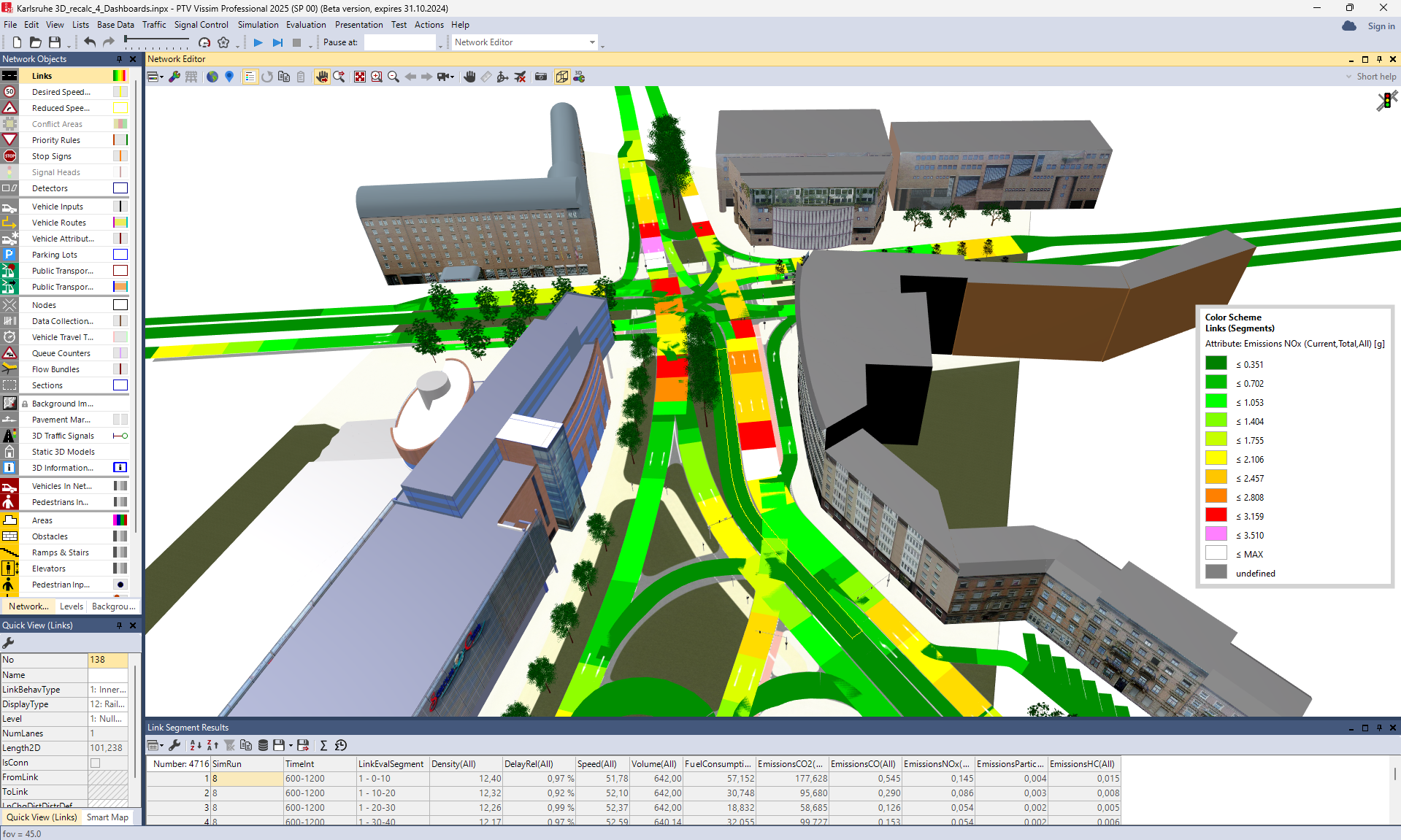
Microscopic traffic simulation makes these effects measurable before implementation. PTV Vissim calculates emission and fuel consumption impacts based on high-resolution vehicle trajectory data, reflecting realistic speed, acceleration and deceleration patterns under operational conditions.

Scenario comparison enables planners to quantify emission trade-offs at corridor and network level. By linking operational indicators such as delay and queue formation with emission metrics, cities gain a robust basis for validating decarbonization and air quality strategies before implementation.

Traffic Safety Analysis & Vision Zero

Road safety performance is influenced by vehicle interactions, speed distributions and traffic control conditions across the network. Understanding where conflicts occur is essential for improving safety before crashes happen.

Microscopic traffic simulation enables predictive traffic safety analysis based on detailed vehicle, cyclist and pedestrian trajectories under realistic operating conditions. PTV Vissim simulates multimodal interactions at intersections and along corridors, making potential conflict situations visible before incidents occur. 

These trajectories allow surrogate safety indicators such as Time-to-Collision (TTC), Post-Encroachment Time (PET) and deceleration patterns to be derived to identify conflict-prone locations across the network.

Combined with operational metrics such as delay and queue formation, these safety indicators provide a structured basis for evaluating infrastructure redesign and signal strategies aligned with Vision Zero principles.

Why traffic planners use PTV Vissim

Realistic Traffic Behavior

Model realistic driving, cycling and walking behavior in detail.

True Multimodal Simulation

Simulate cars, bikes, pedestrians and transit interacting in one model.

Evidence for Better Decisions

Use measurable indicators to support safer, sustainable mobility plans.

Design Safer Streets

Test street redesigns and identify conflict risks before changes.

Evaluate Emission Impacts

Assess how mobility measures influence traffic emissions.

Advanced Signal Control

Test fixed, actuated and adaptive signal strategies in simulation.

PTV Vissim provides decision-makers with confidence

Nissan Customer Logo (color) Nissan Customer Logo (color)
Atkins Customer Logo (unicolor) Atkins Customer Logo (color)
Aecom Customer Logo (color) Aecom Customer Logo (color)
Dortmund Customer Logo (unicolor) Dortmund Customer Logo (color)
Bonn Customer Logo (unicolor) Bonn Customer Logo (color)
Mazda Logo Mazda Logo
Hyundai Hyundai

Ready for advanced insights? Take the next step – in-depth expert sessions

Sign up to access expert-led Customer Webinars that explore how PTV Vissim is applied in complex, real-world projects. Industry specialists and academic partners present methodologies, challenges, and lessons learned from practice. Registration is required to unlock the full series.

Unlock the Customer Webinars

Success Stories: Learn how our customers use PTV Vissim

Any questions? Just get in touch.