Search for content
PTV Vissim

Plan New Neighborhoods with Confidence - Before Construction Begins

PTV Vissim is the authority-grade traffic simulation platform that de-risks residential development projects before construction begins. It delivers true behavioral realism, integrated multimodal modeling, and approval-ready outputs that withstand planning scrutiny. By capturing street-level interactions and operational impacts, PTV Vissim ensures new neighborhoods perform as intended – not just in theory, but in real-world operation.

Download demo  Contact us

Planning of new residential or commercial areas

New developments introduce additional traffic demand that affects surrounding corridors, intersections, and multimodal accessibility.  

Without realistic traffic simulation, capacity constraints, queue spillback, and safety issues may only become visible after construction. 

PTV Vissim enables planners to simulate projected residential or commercial traffic within the existing network before implementation. Future traffic volumes, multimodal traffic flows, and infrastructure layouts can be tested under peak conditions to assess operational network performance. 

Intersection capacity, queue formation, and multimodal interactions between vehicles, cyclists, and pedestrians can be evaluated across alternative access concepts and street hierarchies. 

Scenario comparison and measurable KPIs such as delay, travel time, and level of service provide a reliable basis for technical documentation and approval processes. 

Traffic impact analysis

When new developments or infrastructure changes are proposed, traffic impact analysis determines whether the existing network can absorb additional traffic without compromising performance or safety. Reliable, transparent results are essential for technical validation and regulatory approval. 

Microscopic traffic simulation makes this assessment measurable: PTV Vissim enables planners to simulate baseline and future traffic scenarios within the same environment, introducing additional traffic volumes under defined peak conditions to analyse their impact on intersections, corridors and overall network capacity. 

By explicitly representing multimodal interactions between vehicles, cyclists, pedestrians and public transport, the simulation reveals how congestion develops, where queues form and how performance changes across the network. Key indicators such as queue length, delay, level of service and travel time reliability provide objective evidence at critical locations. 

Scenario comparison then allows mitigation measures – such as geometric adjustments or signal timing changes – to be evaluated under consistent demand assumptions before implementation. 

Parking planning

Parking decisions directly influence traffic circulation, congestion levels, and multimodal accessibility. Limited parking supply, high peak demand and poorly designed access geometry can generate search traffic, queue spillback and localized congestion in adjacent corridors and intersections.  

PTV Vissim allows planners to evaluate parking concepts within the full network context before implementation. On-street and off-street facilities, access and exit points, and internal circulation can be realistically simulated to assess queue formation, spillback risks, re-entry effects, and impacts on adjacent intersections, bus lanes, and bicycle infrastructure. 

Different demand scenarios — from peak-hour pressure to parking space reduction strategies — can be tested and compared. Integrated pedestrian simulation also captures walking flows between parking facilities and destinations, including drop-off and pick-up activity. Key performance indicators such as delay, queue length, traffic circulation, and level of service ensure parking strategies are assessed based on measurable operational performance. 

Urban street design

Street design decisions shape long-term mobility performance, safety, and urban quality. Choices related to lane allocation, cross-sections, turning lanes, or shared spaces directly influence capacity, traffic flow, and multimodal accessibility. 

PTV Vissim enables planners to test alternative road space configurations in a realistic microscopic traffic simulation before implementation. Different lane layouts, street hierarchies, and multimodal corridor concepts can be compared under consistent demand conditions to evaluate their operational impact. 

Within this traffic simulation, interactions between vehicles, cyclists, and pedestrians become visible across each design options.  

Capacity constraints, queue formation, and potential conflict areas can be identified across alternative street layoutsScenario comparison then provides a structured basis for selecting road space concepts that balance efficiency, safety, and liveability. 

Signalization planning

Signalized intersections often determine whether a new development operates efficiently or turns into a recurring bottleneck. Poor timing or coordination can quickly undermine corridor performance and affect safety. 

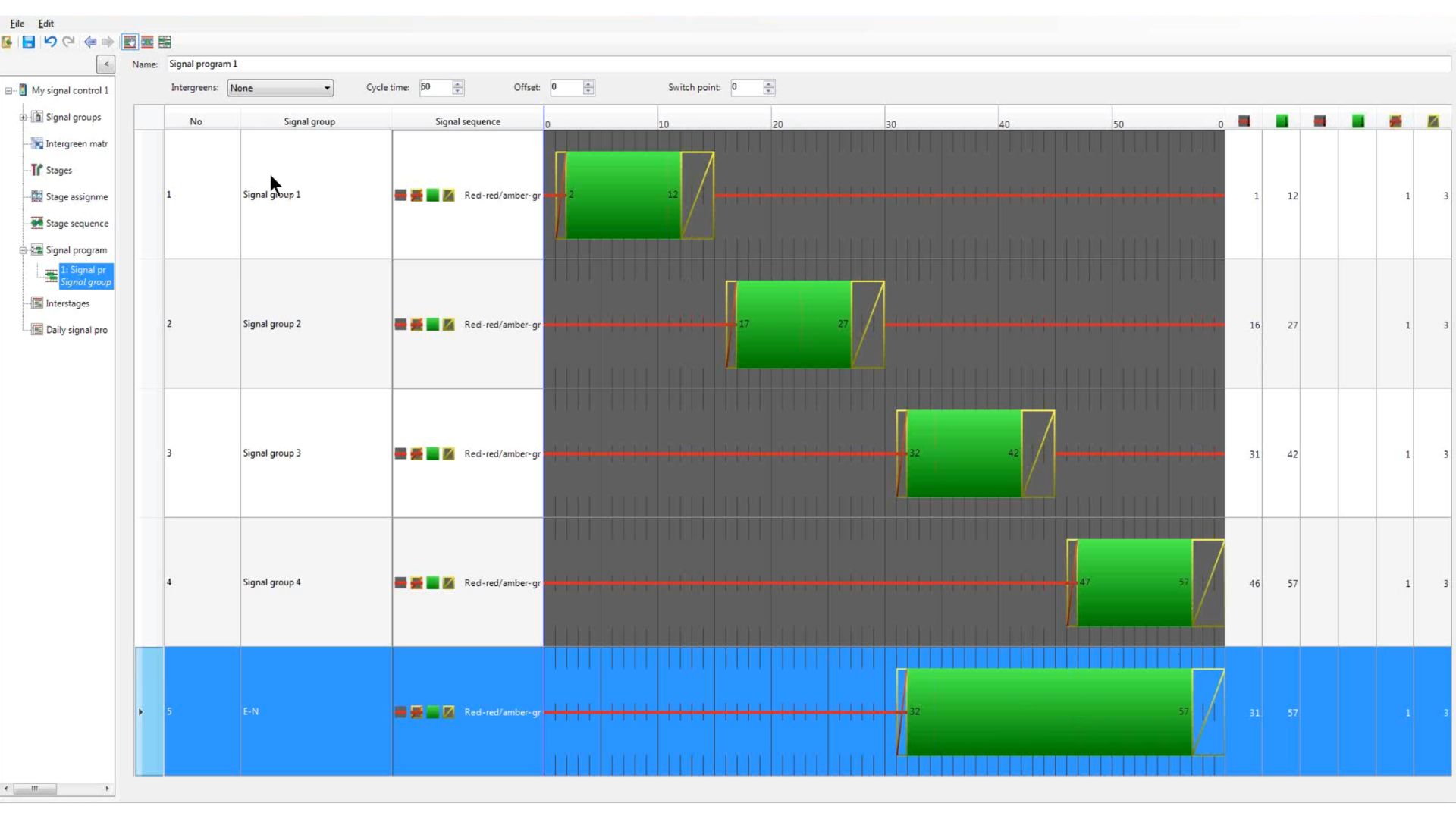
PTV Vissim enables planners to test signal control strategies in a realistic microscopic traffic simulation prior to field implementation. Fixed-time, actuated, or adaptive control concepts can be evaluated under projected traffic conditions to understand how they influence intersection and corridor performance. 

The simulation makes these effects measurable. Indicators such as delay, queue length, and level of service reveal how performance changes under different signal timing strategies. Corridor coordination and signal progression can also be assessed, including the integration of pedestrian and cyclist phases within signal timing plans. Through structured scenario comparison, alternative signal control strategies can be evaluated to ensure traffic flow, coordinated progression and safe multimodal operation. 

Why traffic planners use PTV Vissim

Plan with operational certainty

Simulate future residential and commercial traffic volumes before construction begins. Identify capacity constraints, queue spillback risks, and network stress points early - reducing redesigns, delays and approval uncertainty.

Quantify capacity under future demand

Test projected peak-hour volumes within the existing network. Evaluate intersection performance, corridor load, and level of service using measurable, scenario-based results.

Analyze real street-level behavior

Simulate vehicles, cyclists, and pedestrians in one integrated environment. Assess interaction dynamics, conflict areas, and accessibility impacts within new developments.

Understand circulation effects

Test parking supply, access design, and curbside strategies within the full network context. Identify bottlenecks, re-entry conflicts, and spillback risks before implementation.

Operational impacts on surrounding corridors

Produce measurable indicators including delay, queue length, travel time, and level of service. Provide transparent, technically defensible results for planning documentation and stakeholder review.

PTV Vissim provides decision-makers with confidence

Nissan Customer Logo (color) Nissan Customer Logo (color)
Atkins Customer Logo (unicolor) Atkins Customer Logo (color)
Aecom Customer Logo (color) Aecom Customer Logo (color)
Dortmund Customer Logo (unicolor) Dortmund Customer Logo (color)
Bonn Customer Logo (unicolor) Bonn Customer Logo (color)
Mazda Logo Mazda Logo
Hyundai Hyundai

Ready for advanced insights? Take the next step – in-depth expert sessions

Sign up to access expert-led Customer Webinars that explore how PTV Vissim is applied in complex, real-world projects. Industry specialists and academic partners present methodologies, challenges, and lessons learned from practice. Registration is required to unlock the full series.

Unlock the customer webinars

Success Stories: Learn how our customers use PTV Vissim

Success story
Modeling a Car-lite District in Singapore with PTV Vissim

Fewer cars, more bicycles and pedestrians: Planners use PTV Vissim models to propose human-centered mobility in the developing East Coast Extension district.

Learn more

Any questions? Just get in touch.